Motor Noise Part : Normal Bearing Sound vs Abnormal Noise – Can You Tell the Difference?
Even with advanced manufacturing technology, bearings inevitably generate noise—a fundamental relationship between their inherent vibration and sound. This occurrence of vibration and sound does not necessarily indicate a performance issue or imminent failure. The key is distinguishing between normal operational sounds and signals of abnormality.
Several Common Types of Normal Bearing Sounds
1. Raceway Sound
Raceway sound is the most fundamental noise generated by all rolling bearings and is typically the benchmark for noise standards.
Mechanism: Despite superior machining, microscopic waviness and form errors remain on the raceways of bearing rings and the surfaces of rolling elements. These imperfections cause slight variations in the contact elasticity between the raceways and rolling elements. These variations in elastic force act as a micro-excitation force on the bearing rings, resulting in vibrations perceived as raceway sound.
Characteristics:
Noise and vibration are random.
Vibration frequency is above 1 kHz.
The dominant noise frequency remains almost constant regardless of speed changes, but the sound pressure level increases with rotational speed.
Sound pressure level increases sharply with larger radial internal clearance.
Increased housing rigidity lowers the overall sound pressure level; even with speed increases, the rise in sound pressure level is minimal.
Higher lubricant viscosity leads to a lower sound pressure level. For grease lubrication, both base oil viscosity and the shape/size of soap fibers can influence noise levels.
Note: The acoustic energy excited by raceway sound is limited. For example, a high-quality 6203 bearing typically produces a raceway sound in the range of 24–27 dB (sound pressure level) under normal conditions.
2. Roller Drop Sound (Tumbling Noise)
This sound occurs more frequently in medium to large bearings under radial load, primarily at low speeds, and typically disappears at higher rotational speeds.
Mechanism: Under radial load, a loaded zone and an unloaded zone form inside the bearing. In the unloaded zone, due to internal clearance, the rolling elements lose contact with the inner ring. At higher speeds, centrifugal force pushes them against the outer ring. Conversely, at low speeds, reduced centrifugal force allows the rolling elements to "drop," creating an impact sound against the cage or inner ring.
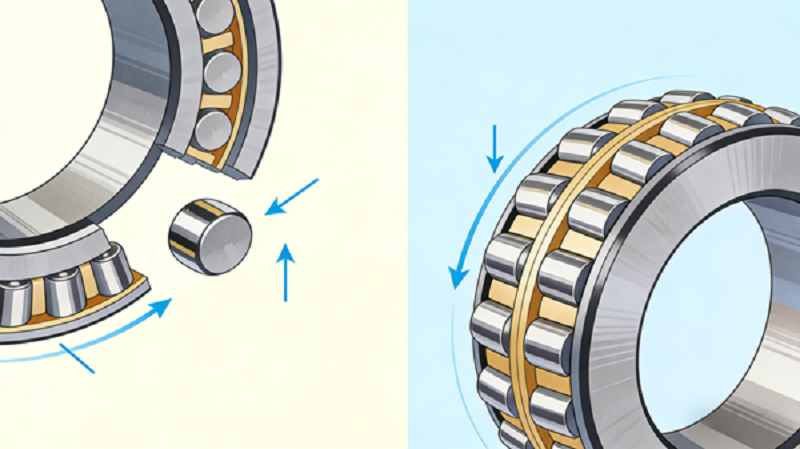
Characteristics:
More likely with grease lubrication than oil lubrication.
Prone to occur with applied radial load only and larger radial clearance.
Occurs within a specific speed range, which varies by bearing size.
May be continuous or intermittent.
This forced vibration often excites the second or third-order bending natural vibrations of the outer ring, emitting the characteristic noise.
Countermeasures: Apply preload; reduce radial internal clearance; use lighter rolling elements (e.g., ceramic).
3. Bearing Squeal (Howling Noise)
Squeal is an intense, high-pitched screeching sound. Bearings emitting squeal usually do not experience temperature rise, and the lifespan of the bearing or grease is not adversely affected. This noise can often be tolerated if noise level is not a critical factor.
Mechanism: Due to radial internal clearance, rolling elements form a passage that is wider at the entry and narrower at the exit of the load zone. At certain speeds, rolling elements vibrate between the inner and outer rings. As they enter the constricted load zone, the vibration frequency increases, generating sharp, high-frequency noise.
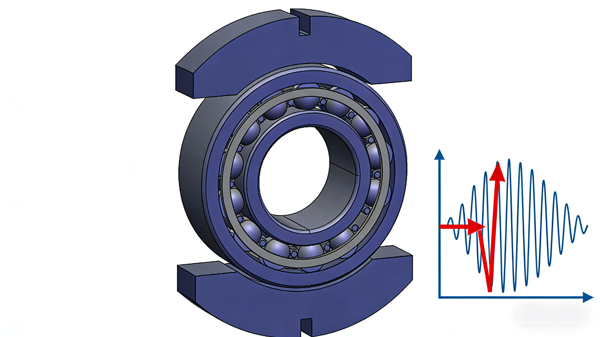
Characteristics:
More likely with larger radial internal clearance.
Common in grease-lubricated bearings; rare with oil lubrication.
Very high and sharp frequency.
Appears within a specific speed range and diminishes outside it; generally not present at very low speeds.
Adding grease may temporarily eliminate the squeal, but it often returns after grease distribution stabilizes and excess is purged.
Countermeasures: Improve the wedge-shaped space (e.g., apply axial preload to deep groove ball bearings); use a relatively smaller clearance for cylindrical roller bearings (e.g., change from standard C3 to C3L clearance); use a higher-consistency grease.
Abnormal Bearing Sounds Indicating Damage
Bearing components have very hard surfaces. Incorrect handling, installation errors, or impact from dropping can leave marks (damage) on working surfaces. Even minor surface imperfections can become a source of vibration and noise.
1. Damage Sound (Flaw Noise)
Characteristics: If raceway surfaces have scratches, dents, rust, or other damage, the bearing will emit a periodic pulsing or clicking sound during rotation. At a constant speed, the sound occurs at a fixed period (time interval). Slower speed results in a longer period between sounds.
Mechanism: Damaged spots on the raceway strike against the rolling elements as the bearing rotates, generating impact sounds.
Countermeasure: Replace the bearing during maintenance. Crucially, avoid applying impact loads during installation.
2. Contamination Noise (Dirt Sound)
Characteristics: Insufficient cleaning during bearing installation, foreign particles in the lubricant, or debris entering the bearing during operation can cause a "crunching," "grating," or "hissing" sound. This irregular and variable noise occurs as contaminants pass through the rolling contact areas.
Mechanism: Hard particles indent the raceways and rolling elements, creating continuous minor impacts.
Countermeasure: Contamination not only causes noise but also creates indentations on raceways, significantly shortening bearing life. It is essential to handle and install bearings in a clean environment and employ effective sealing methods to prevent ingress.
Conclusion
Understanding the symphony of sounds a bearing produces is crucial for predictive maintenance. Distinguishing harmless operational noises like raceway sound or occasional low-speed tumbling from the telltale signs of damage (periodic clicking) or contamination (irregular crunching) enables timely and appropriate action. When in doubt, consult a bearing specialist or utilize vibration analysis tools for a definitive diagnosis. Remember, proactive identification of abnormal sounds protects your machinery, prevents unplanned downtime, and optimizes operational efficiency.
Related News
- Why Are 206KRRB6 Hex Bore Series Agricultural Bearings a Smart Choice for Demanding Farm Machinery
- Why Are BAA-0003 Agricultural Hub Units a Smart Choice for Demanding Farm Machinery
- Why Are GW208PPB5 Square Bore Agricultural Bearings a Smart Choice for Demanding Farm Machinery
- How Does a Deep Groove Ball Bearing Improve Machine Performance?
- How Do Turbocharger Bearings Improve Turbocharger Performance and Reliability?
- How Do Clutch Release Bearings Improve Vehicle Performance and Driving Comfort?
Leave me a message